Wrongful Arrest by Facial Recognition: The Robert Williams Case
An AI ethics case study on how faulty facial recognition led to a wrongful arrest — and what better governance could prevent.
Category
Deck / Document
Year
2026
Role
Built by Ryan Fahrein
Proof
1 asset
Overview
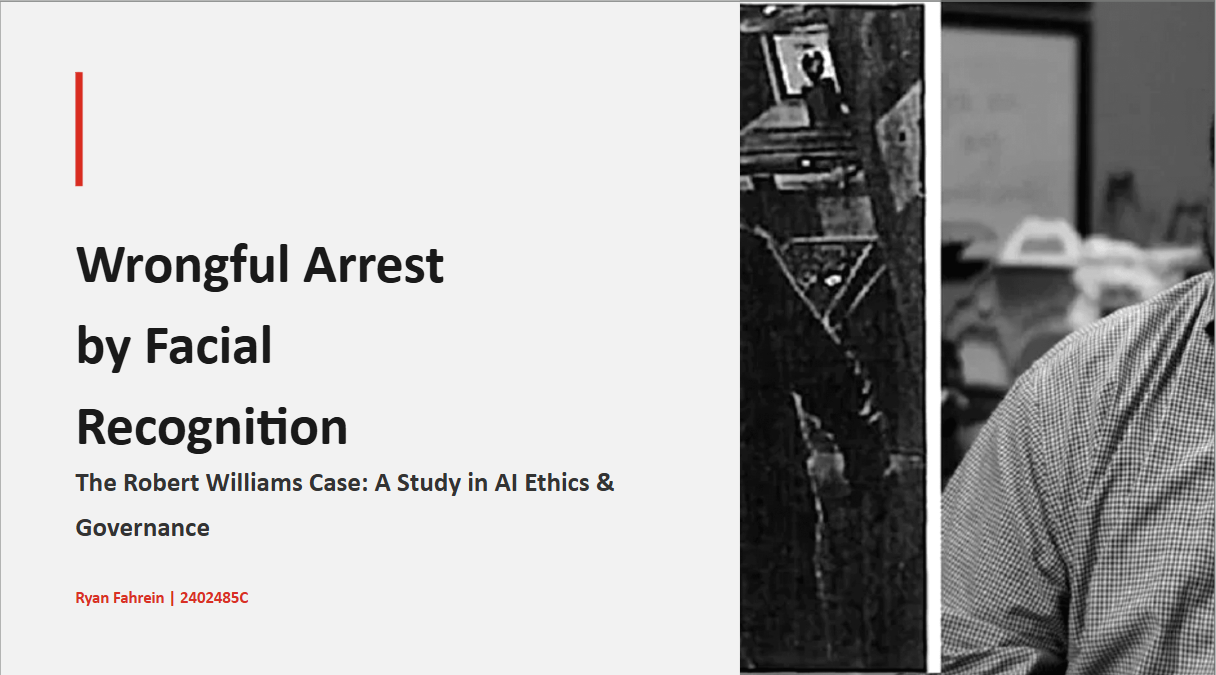
I created a presentation analyzing the wrongful arrest of Robert Williams, the first publicly documented case in the United States where facial recognition technology directly contributed to a wrongful arrest. The project matters because it shows how AI systems can cause real-world harm when bias, poor image quality, weak oversight, and blind trust in technology enter high-stakes areas like criminal justice. This project breaks down the Robert Williams case as a study in AI ethics and governance. It explains how Detroit Police used facial recognition technology to match blurry CCTV footage against a large image database, how that match was treated as stronger evidence than it should have been, and how this led to violations of justice, racial bias, and loss of trust. My role was to research the case, identify the key stakeholders, analyze the ethical issues, and propose technical and policy solutions such as bias testing, confidence thresholds, human-in-the-loop review, officer training, audit logs, and stronger SOPs.
Problem: An AI ethics case study on how faulty facial recognition led to a wrongful arrest — and what better governance could prevent.
Outcome: This project highlights the importance of designing AI systems that support human judgment rather than replace it. It demonstrates how ethical AI requires not just better algorithms, but also stronger governance, transparency, accountability, and multidisciplinary oversight to prevent biased technology from amplifying injustice.
Tools and skills
Gallery and assets
Live project viewer